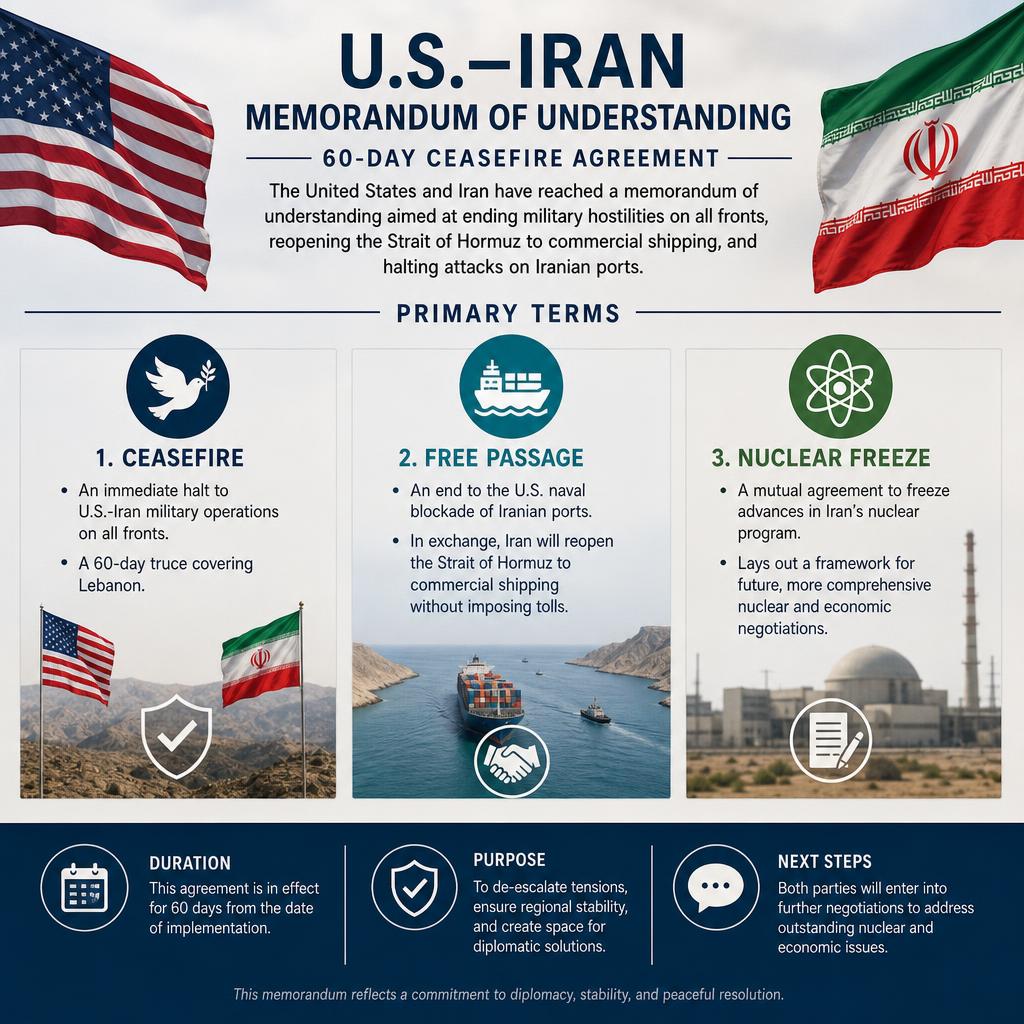

The “Iran deal” is a 14-point temporary framework agreement officially signed as a Memorandum of Understanding (MoU) between the United States and Iran.
Brokered after a volatile three-and-a-half-month military conflict, the initial pact establishes a 60-day ceasefire to halt hostilities, reopen vital shipping lanes, and lay the groundwork for long-term peace and nuclear negotiations.
Maritime and Military Ceasefire
- Strait of Hormuz Reopens: Iran agreed to open the vital trade corridor toll-free for the 60-day window, moving to clear undersea mines and military obstacles….
- Blockade Lifted: The United States immediately terminated its naval blockade on Iranian ports, allowing cargo to flow.
- Regional Truce: The agreement dictates an “immediate and permanent” end to military operations on all fronts, which explicitly covers Lebanon to cool down border escalations with Hezbollah.
- Troop Drawdown: The U.S. committed to moving military forces out of the immediate proximity of Iran within 30 days of a finalized deal.
Economic Concessions & Reconstruction
- Oil Export Waivers: The Trump administration granted immediate sanctions waivers, allowing Iran to freely sell its crude oil on the open global market to jumpstart its economy.
- $300 Billion Reconstruction Fund: The U.S. and regional partners plan to establish a multi-billion dollar development fund for Iran. White House officials clarified that the U.S. itself will not pay a single cent, implying Gulf Arab states will provide the capital.
- Frozen Assets: The U.S. pledged to begin releasing tens of billions of dollars in frozen Iranian assets as compliance benchmarks are achieved.
Nuclear and Regional Security Mandates
- Uranium Downblending: Rather than dismantling its nuclear infrastructure, Iran’s interim mandate is to “downblend” its existing highly enriched uranium stockpile on-site under International Atomic Energy Agency (IAEA) supervision.
- No Nuclear Weapons: Iran reiterated its baseline commitment to never procure or develop nuclear weapons.
- Unresolved Omissions: The preliminary framework entirely omitted restrictions on Iran’s ballistic missile program and its funding of regional proxy groups, deferring those issues to the subsequent 60-day bargaining window.
Community Perspectives on the Deal
The agreement has sparked intense global debate, with critics arguing the U.S. surrendered too much upfront leverage for minimal immediate concessions. Highlighting the financial windfalls heading to Tehran, Bloomberg Opinion columnist Javier Blas observed:
Conversely, proponents of the strategy frame it as a necessary step to avoid catastrophic economic fallout. Vice President JD Vance defended the economic setup of the reconstruction fund during a White House briefing:
However, regional analysts remain skeptical of long-term compliance given the current political climate. Highlighting the ongoing human rights abuses inside Iran, political activist Reza Pahlavi noted:
The 60-day clock is currently running for both nations to hammer out a final, comprehensive treaty. While President Trump hailed the MoU for preventing an “economic catastrophe”, he warned that if negotiations stall or if Iran breaches the truce, the U.S. military is fully prepared to resume bombing operations. Any final deal reached at the end of this window will require formal endorsement by a binding UN Security Council resolution