


For years, Texas Gov. Greg Abbott has been one of the most powerful political figures in the state, building a formidable campaign operation and accumulating support from some of Texas’s wealthiest business leaders. But that political network has increasingly drawn scrutiny from watchdog groups, journalists and Abbott’s political opponents, who argue that the governor’s relationships with major donors raise troubling questions about the intersection of campaign money and state government.
The accusations range from cronyism and favoritism to allegations of a broader pay-to-play political culture in which companies and executives that contribute heavily to Abbott’s political operation can benefit from lucrative government contracts.
Those allegations became more prominent after a 2025 report by Public Citizen examined emergency, noncompetitive contracts awarded by Texas state agencies.
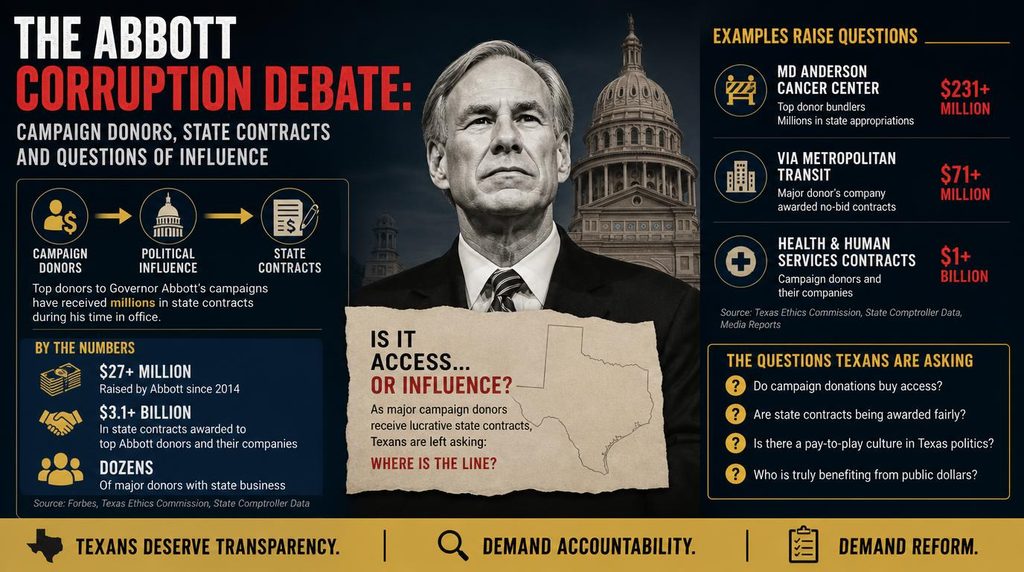
Nearly $1 Billion in No-Bid Contracts
Public Citizen reported that companies, executives, political action committees and others connected to donors to Abbott’s political operation received approximately $950 million in no-bid state contracts between 2020 and 2024.
The watchdog group identified 89 contracts involving companies or individuals who had contributed to Texans for Greg Abbott, Abbott’s political action committee. The contracts were awarded during declared emergencies, including the COVID-19 pandemic, border-security operations and Hurricane Beryl. (Public Citizen)
Public Citizen’s report identified eight companies that received noncompetitive emergency contracts while people affiliated with those companies made significant contributions to Abbott’s political operation. In some cases, the donations occurred before or around the time the companies received contracts.
That timing is at the heart of the controversy.
A contribution to a politician does not, by itself, establish that a government contract was awarded because of the contribution. Nor does the receipt of a government contract prove that a company received preferential treatment.
But critics argue that the pattern deserves scrutiny because of the enormous sums of taxpayer money involved.
Public Citizen’s research was careful to distinguish between a documented financial relationship and proof of illegal conduct. The group’s Texas director, Adrian Shelley, told the Houston Chronicle that the report was not intended to establish insider dealing or a legal violation, but rather to highlight what he described as a broader “pay-to-play” system enabled by weak ethics and contracting rules. (Houston Chronicle)
Abbott’s Office Rejects the Connection
The governor’s office has pushed back against the allegations.
According to the Houston Chronicle, Abbott spokesman Andrew Mahaleris said the governor’s office does not participate in the contracting process and characterized Public Citizen’s conclusions as an attempt to create a connection between Abbott and contracts handled by state procurement officials.
That distinction is important.
Texas government contracts are generally administered by state agencies and procurement officials rather than personally awarded by the governor. During declared emergencies, however, state agencies have additional authority to bypass ordinary competitive-bidding requirements.
The Texas Legislative Budget Board maintains a public database containing reported state contracts, allowing Texans to examine contracts by agency, vendor, subject and award date. (Texas Legislative Budget Board)
The central question, therefore, is not simply whether an Abbott donor received a state contract. It is whether political contributions influenced contracting decisions or created an appearance of favoritism that Texas ethics and procurement laws should address.
Political Opponents Turn the Issue Into a Campaign Weapon
Abbott’s Democratic opponent, Gina Hinojosa, has made the issue a central part of her campaign message.
In June 2026, Hinojosa’s campaign placed billboards in Corpus Christi accusing Abbott of a “corruption tax” and alleging that his administration had steered state contracts to political donors. Her campaign characterized the contracts as a billion-dollar giveaway to Abbott’s donors. (Gina Hinojosa for Texas Governor)
Hinojosa has continued to use the issue on the campaign trail, repeatedly pointing to the Public Citizen findings as evidence of what she describes as a political system that benefits wealthy interests at the expense of ordinary Texans. (Gina Hinojosa for Texas Governor)
The language is deliberately political. Calling the arrangement a “corruption tax” goes beyond describing the mechanics of government contracting and turns the issue into an indictment of Abbott’s broader political philosophy.
That distinction matters for voters.
There is a significant difference between documented campaign contributions followed by government contracts and proof that a politician sold government favors in exchange for campaign money.
The former is documented by watchdog research. The latter requires additional evidence.
Texas’ Campaign-Finance System Creates the Appearance Problem
The controversy also raises questions about Texas’ campaign-finance laws.
Texas permits extremely large political contributions, meaning wealthy individuals and corporations can provide politicians with substantial financial support. Abbott has built one of the largest political fundraising operations in the state’s history.
That system creates a potential appearance problem even when no law has been violated.
Imagine a company gives millions of dollars to a governor’s political operation and later receives a multimillion-dollar government contract. If the contract was legitimately awarded through an independent procurement process, the transaction may be entirely lawful.
But taxpayers can reasonably ask whether the donor received special access, whether competing companies had a fair opportunity, and whether government officials involved in the decision were sufficiently independent from the governor’s political operation.
Those questions become even more important when contracts are awarded without competitive bidding.
Emergency Contracting Is at the Center of the Debate
There is an important reason many of the contracts identified by Public Citizen were no-bid contracts: Texas law allows governments greater flexibility during declared emergencies.
Emergency procurement can be essential. During a hurricane, pandemic or other crisis, waiting weeks or months for a traditional bidding process could delay critical services.
The problem arises when emergency declarations and exceptions to competitive bidding become common enough that watchdogs begin questioning whether the system provides sufficient safeguards.
Public Citizen has argued that Texas should strengthen its procurement rules, increase transparency surrounding emergency contracts and establish stronger restrictions designed to prevent the appearance of political influence in contracting. (Public Citizen)
These proposals do not necessarily depend on proving that Abbott personally directed a particular contract.
Instead, they focus on creating rules that make it harder for any governor, regardless of political party, to benefit politically from relationships with government contractors.
A Question of Trust
Ultimately, the controversy surrounding Abbott is about more than a list of contracts or campaign contributions.
It is about public confidence.Government contracts involve taxpayer money. When companies that make significant political contributions subsequently receive large government contracts, voters are entitled to ask how those decisions were made.
At the same time, allegations of corruption should not be treated as established facts without evidence showing that a contract was awarded improperly or in exchange for political support.
The available evidence establishes a documented overlap between Abbott donors and companies that received significant no-bid emergency contracts. Public Citizen’s research has brought that pattern into public view. Abbott’s office disputes the significance of the connection and says the governor’s office does not control the contracting process. (Public Citizen)
That leaves Texas voters with a fundamental question:
Even if the transactions are legal, are the state’s safeguards strong enough to ensure that political influence cannot shape who receives taxpayer-funded contracts?
For Abbott’s critics, the answer is clearly no.
For the governor’s defenders, the existence of campaign contributions alongside state contracts does not demonstrate wrongdoing.
The debate over those competing interpretations is likely to remain a significant issue in Texas politics—and the public records surrounding campaign donations and state contracts give voters the ability to examine the evidence for themselves.


