


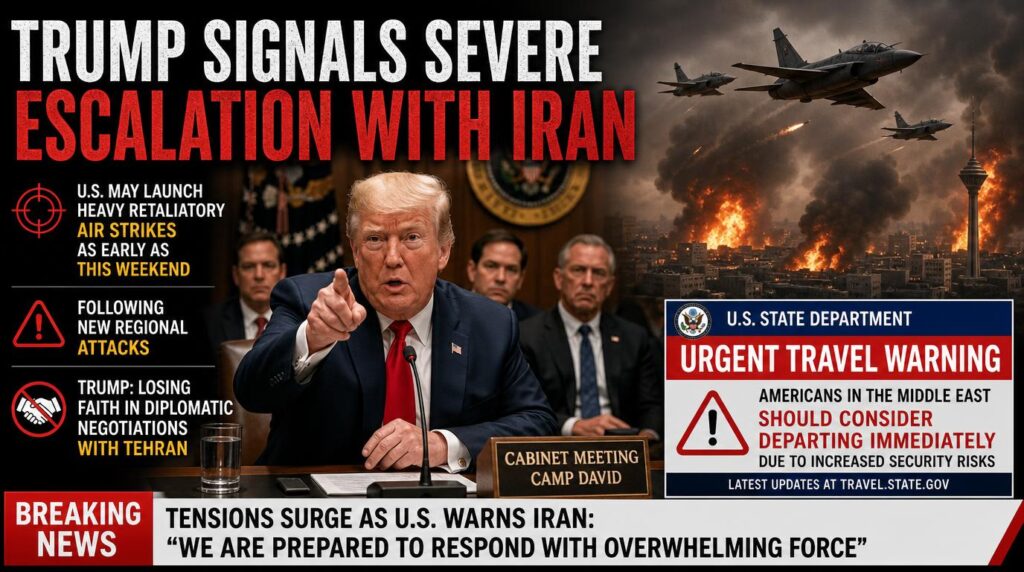
President Donald Trump Signals Severe Escalation in Conflict with Iran
In a recent televised Cabinet meeting held at Camp David, President Donald Trump issued a stark warning indicating a potential severe escalation in the ongoing conflict with Iran. The President suggested that the United States might launch heavy retaliatory air strikes as early as this weekend, following a series of new attacks in the region attributed to Iranian forces or their proxies.
Trump expressed growing frustration and a waning confidence in diplomatic efforts with Tehran, signaling a possible shift away from negotiations toward a more aggressive military posture. His remarks underscore the heightened tensions and the risk of a broader conflict in the Middle East.
Adding to the gravity of the situation, the U.S. State Department has released urgent travel advisories. These warnings urge American citizens currently in the Middle East to consider leaving the region immediately due to escalating security concerns. The advisory highlights the increased risk of violence and instability, reflecting the administration’s anticipation of intensified hostilities.
This development marks a critical juncture in U.S.-Iran relations, as diplomatic channels appear to be faltering and the prospect of military confrontation grows more imminent. Observers around the world are watching closely, aware that any further escalation could have significant implications for regional and global security.
Middle East and Foreign Policy Developments
Iran Conflict
As the conflict in Iran enters its sixth month, the U.S. military is maintaining a naval blockade aimed at restricting Iranian movements and influence in the region. The situation remains tense following renewed Iranian drone activity and attacks near regional U.S. bases, prompting Washington to assess strategic targets such as Pickaxe Mountain. In parallel, a Senate war powers resolution intended to challenge former President Trump’s military actions recently failed by a narrow margin of 49–50 votes, highlighting deep divisions in Congress over the U.S. approach to Iran.
Gaza Disarmament Plan
Former President Trump has announced a potential framework aimed at the complete disarmament of Hamas in Gaza. The plan proposes that Hamas would relinquish its weapons in exchange for an Israeli withdrawal from certain territories. However, senior Israeli officials have emphasized that the details of implementation and formal acceptance by all parties involved remain uncertain. The proposal has yet to gain substantial traction in the region, underscoring the complexity of achieving lasting peace in Gaza.
Domestic Policy and Nominations
Todd Blanche Nomination
The nomination of acting Attorney General Todd Blanche by President Trump is facing significant obstacles within the Republican Party. Key GOP senators, including John Cornyn and Thom Tillis, are withholding support pending written commitments related to a controversial $1.8 billion “anti-weaponization” compensation fund. These senators are demanding clear assurances on how the fund will be managed and allocated. In response, Trump has threatened to either withdraw or delay Blanche’s nomination until these senators exit office, signaling ongoing intra-party tensions.
Lincoln Reflecting Pool Dispute
Federal prosecutors have moved to drop vandalism charges against a former Olympian accused of damaging the Lincoln Memorial Reflecting Pool. Investigations revealed that the damage was the result of a botched contractor installation rather than intentional vandalism. Despite these findings, former President Trump publicly rejected the conclusion on social media, insisting on a different narrative. The case highlights broader debates about accountability and the interpretation of public incidents within the current political climate.


