

The Republican Party, also known as the GOP (Grand Old Party), was founded in 1854 in response to the Kansas-Nebraska Act, which allowed the expansion of slavery into new territories. It emerged as a coalition of anti-slavery activists, modernizers, ex-Whigs, and ex-Free Soilers who opposed the spread of slavery. The party quickly gained support in the Northern states and became the principal opposition to the Democratic Party.
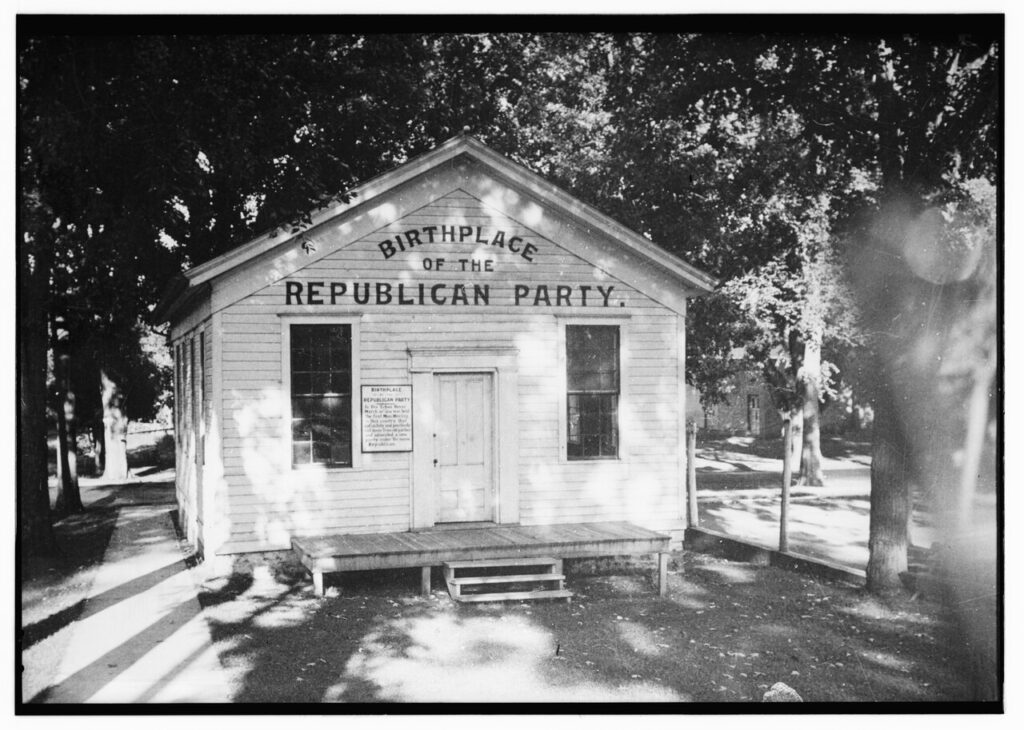
Birthplace of the Republican Party
Birthplace of the Republican Party in the Little White Schoolhouse in Ripon, Wisconsin…1850s to 1930s
Abraham Lincoln was the first Republican president, elected in 1860. His election led to the secession of Southern states and the Civil War. Under Lincoln’s leadership, the Republican Party was associated with preserving the Union and abolishing slavery through the Emancipation Proclamation and the 13th Amendment.

After the Civil War, the Republican Party dominated national politics during the Reconstruction era, advocating for civil rights and the rebuilding of the South. In the late 19th and early 20th centuries, the party was known for supporting business interests, industrialization, and economic growth.
Throughout the 20th century, the Republican Party underwent several ideological shifts. It embraced conservatism, advocating for limited government, free-market capitalism, and a strong national defense. Key figures include Theodore Roosevelt, who promoted progressive reforms, and Ronald Reagan, whose presidency in the 1980s marked a conservative resurgence emphasizing tax cuts, deregulation, and a tough stance on the Soviet Union.
Shift Rightward
After the Civil Rights Act of 1964, the Voting Rights Act of 1965, and the Southern strategy, the party’s core base shifted with the Southern states becoming more reliably Republican in presidential politics and the Northeastern states becoming more reliably Democratic. White voters increasingly identified with the Republican Party after the 1960s. Following the Supreme Court’s 1973 decision in Roe v. Wade, the Republican Party opposed abortion in its party platform and grew its support among evangelicals. The Republican Party won five of the six presidential elections from 1968 to 1988. Two-term President Ronald Reagan, who held office from 1981 to 1989, was a transformative party leader. His conservative policies called for reduced social government spending and regulation, increased military spending, lower taxes, and a strong anti-Soviet foreign policy. Reagan’s influence upon the party persisted into the 21st century.
Today, the Republican Party remains one of the two major political parties in the United States, often associated with conservative positions on economic policies, social issues, and national security. Its history reflects a complex evolution shaped by changing political, social, and economic contexts.